
Boiler outlet: what changes at peak demand?
Review outlet pressure and, where metered, steam flow as equipment starts and during steady production. A pressure dip that coincides with several loads starting is a reason to review peak demand and how the boiler responds.
Distribution: where does condensate go?
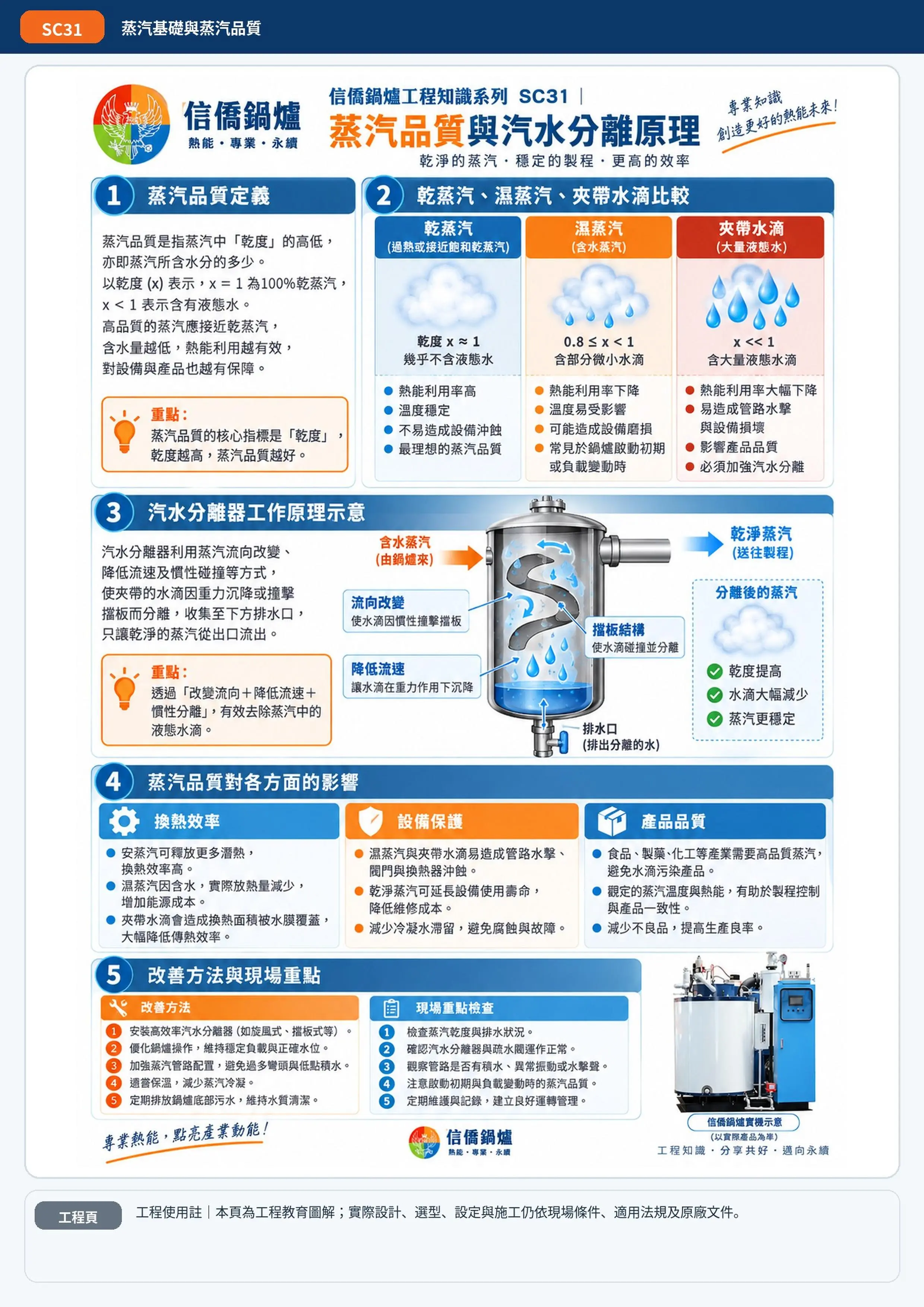
Steam releases heat as it condenses. Some condensation happens in the piping as it loses heat, even when insulated. Steam traps drain condensate from the system, while separators remove droplets suspended in the steam. Pipe sizing and layout also affect how much pressure is lost before steam reaches the equipment.
Equipment inlet: does the steam meet the process requirements?
Compare inlet pressure, temperature and, where measured, flow with the equipment requirements. For saturated steam, dryness describes the fraction of the mixture’s mass that is vapour. A pressure gauge alone cannot tell you the steam dryness. Ask a specialist to assess moisture if the process is sensitive to it.
For example, if only one heat exchanger heats more slowly while boiler outlet pressure stays steady, compare that branch’s inlet readings and ask the maintenance team to check the equipment and its condensate drainage. If several lines slow down together, also review the shared steam main and when the loads overlap.
What to record before a site assessment
- When it happens: during warm-up, steady production or when several pieces of equipment are running at once.
- Boiler outlet and equipment inlet readings taken at the same time, plus steam flow if metered.
- Which equipment was affected, its usual heat-up time and the time it took when the issue occurred.
Use existing gauges and logs for these comparisons. Have qualified personnel inspect pressurised equipment and pipework.
References and further reading
- Taiwan Hsin Chiao — Steam quality and moisture separation FAQ
- Rui Ding — Steam Quality & Process Heating (design preview). The guide considers steam conditions at the equipment inlet.
- Spirax Sarco — Steam Mains and Drainage
- Spirax Sarco — Pipes and Pipe Sizing